|
|||||||||
|
|
Welcome
to |
||||||||
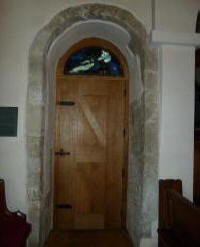
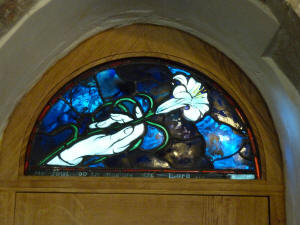
Opposite the south entrance door is a stained glass window designed by John Piper and commemorating the small church of St Saviour’s in nearby Turville heath which closed in 1972. It is above the new disabled access door which also leads to the new toilet facility.
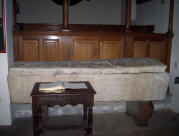
In front of the north aisle, a stone coffin discovered beneath the pulpit during the 1901 restoration and found to contain two skeletons the later 16th century one having a hole in the skull and thought to be that of a murder victim. The coffin is also thought to have been used as an ossuary for churchyard bones dating from a time when the churchyard was overcrowded.
|
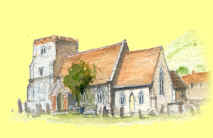
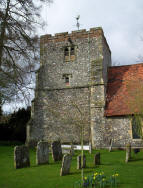
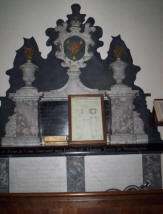
Church History Lands in Turville (name derived from Anglo-Saxon for dry field) were given to St Alban’s Abbey by Egfrid, son of King Offa of Mercia in 796 AD. However the first known church building dates from the 12th century and the first vicar was a Benedictine monk from St Alban’s called Elias in 1228. The church is built principally of flint, the only available material in chalk country in the Middle Ages. The corners of the building have been shaped from limestone or “clunch” a chalk and clay mixture found locally at Watlington. The oldest part is the nave, early 12th century. Rebuilding of the church in 1340 included the present tower and an enlargement of the chancel. The tower is squat in comparison to its massive proportions and is topped with brick. Further rebuilding in 1733 saw the addition of a north aisle as the location for a grander pew for the Lord of the Manor, William Perry and great-grandfather to the poet Percy Bysshe Shelley. The connection of the Perry family are recorded in two fine armorial glass windows in the south wall. On the north aisle there is an ornate marble monument to William Perry.
Other restoration work has been carried out in 1875 (raising of the chancel floor), 1901 (construction of the vestry), 1972 (repair of the roof) and, 1996 (new bell-frame and re-tuned peal). The four bells date from 1670 and 1744. In the north aisle is a copy of Murillo’s Virgin and Child In the churchyard, to the west of the south door, are three dead boards or leaping boards which are inscribed planks supported by upright posts and used as an alternative to tombstones
|
||||||||